LEVERAGING EXPERIENCE. Do we leverage our own experience? Yes. Do we tap into the insights of our colleagues? Occasionally. Do we draw from the collective knowledge of our organization? On occasion. Do we benefit from the expertise of our professional community and industry? Well…
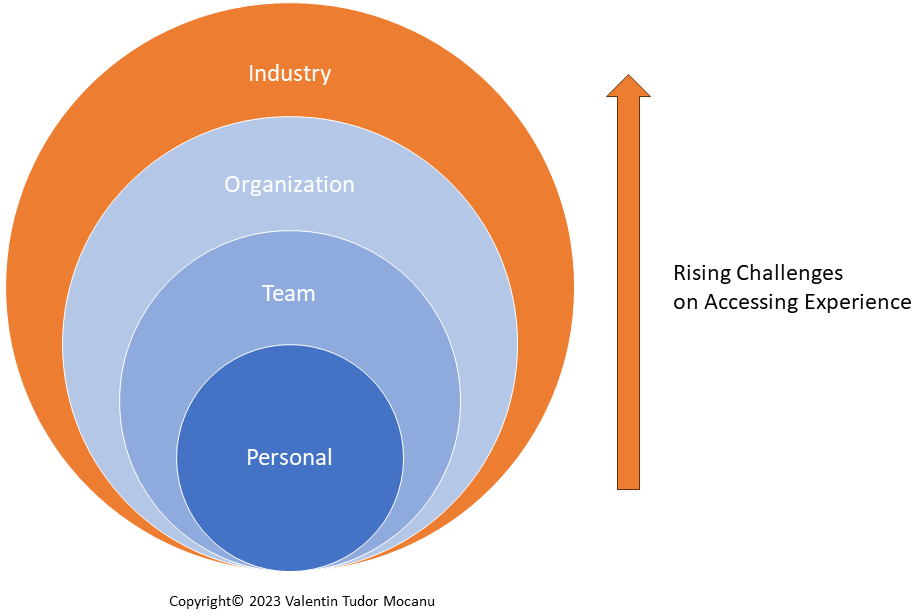
Can we afford to disregard and face challenges in accessing industry experience?
AGILE EXPERIENCE AS PRACTICES. Since the onset of the Agile era, we typically convey our experiences by describing the practices we use and how we adapt the development/delivery life cycle – for instance, transitioning from waterfall to iterative or continuous delivery.
Where can we access resources and guidance regarding Agile practices?
GETTING NEEDED KNOWLEDGE FROM AGILE METHODS. We can utilize the most well-known methods within Agile, such as Scrum and XP (Extreme Programming). How do we align our knowledge needs with what these methods offer? We have several options, for example:
- We can adopt one or more practices from these methods. We can attempt to follow a specific method. Alternatively, we can customize and enhance a method to suit our specific context. We can even combine practices from two or more methods and customize them to suit our needs.
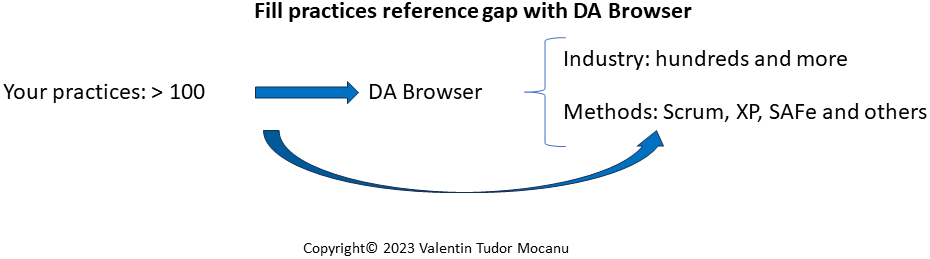
LIMITS OF AGILE METHODS KNOWLEDGE. How many practices do these Agile methods contain? Scrum encompasses a few, while XP boasts at least fifty practices, including approximately twenty practices.
What about the practices that are specific to our process? It’s likely that most of them are not present in these methods. Where can we find references for these practices? We may find them in other Agile methods, or perhaps outside established methods. But where exactly?

USUAL REFERENCES AND THEIR LIMITS. Looking for needed info about practices we can use search engines, or we can use Chat GPT. How soon can we expect a helpful response? For instance, when I inquired with ChatGPT about measures to enhance software quality, this tool provided me with a quality checklist rather than guidance on achieving built-in quality.
Typically, it’s essential to be aware of available options to formulate precise questions and… get useful answers.
EXAMPLES OF PRACTICE INFORMATION NEEDS. Here are some sample questions:
Where can we discover diverse team formation options? What approaches can enhance quality? How can we foster the growth of team members? What strategies are effective for testing? What methods can we employ for release planning?
For more in-depth inquiries: What funding strategy aligns with our goals? How can we ensure that improvements enhance clarity? What’s our approach to release validation? How do we facilitate coordination within teams of teams? What methods do we utilize to explore usage beyond user stories?
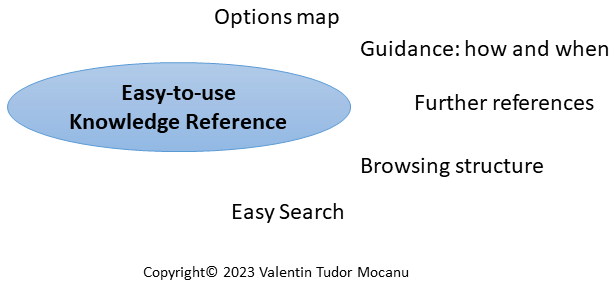
WHAT WE NEED FROM A PRACTICE REFERENCE What we need is a knowledge reference for practices with specific usability properties. An easy-to-use knowledge reference should include the following features:
- Options Map: Providing a clear map of available options.
- Easy Search: Offering a user-friendly search function.
- Guidance on How and When: Providing guidance on how and when to use the available information.
- Further References: Offering additional sources for more in-depth knowledge.
- Browsing Structure: Incorporating an organized and intuitive structure for easy navigation.
DA BROWSER AS A REFERENCE. We have an easily accessible and free online tool – the Disciplined Agile Browser (See [B1 – DA Browser]). Here, we can discover practices from Scrum, XP, SAFe, LeSS, or those that may not be tied to a specific method. How do we find information related to these practices?
We’re equipped with a search tool, or we can navigate through the structured data. It’s categorized into levels: Development/Delivery, DevOps, Value Stream, and Enterprise. Within the development category, practices are organized based on their role in the process. For instance, you can find practices related to Testing Strategy, Quality Improvement, Release Planning, and Funding Strategy.
DA BROWSER SEARCH EXAMPLE. We will search for alternatives to a fixed-price funding strategy. When I search for “fixed price”, I can locate relevant information in various sections, such as “Choose Contract Model” and “Choose Funding Strategy” among others. Then I specifically explore the “Choose Funding Strategy” section and uncover the following options: “Charge by feature,” “Cost plus,” “Time and materials (T&M),” “Stage gate,” “Fixed price/cost (ranged),” and “Fixed price/cost (exact).”
For each of these options, I discover comprehensive guidance on how and when to best utilize them. Additionally, there are supplementary references and a bibliography available on the subject.
How long does the entire process take? Well, it only takes a matter of seconds.
REFERENCES
[B1 – DA Browser] – Disciplined Agile Browser
https://www.pmi.org/disciplined-agile/da-browser
[B2 – Scrum guide] – Scrum guide online
https://scrumguides.org/scrum-guide.html
[B3 -XPE1] – Extreme Programming Explained First Edition, By Kent Beck, Addison-Wesley, 1999
[B4 -XPE2] – Extreme Programming Explained: Embrace Change, Second Edition, By Kent Beck, Cynthia Andres, Addison-Wesley, 2004
[B5 – DA-LC] – Full Delivery Life Cycles
 Improve With Agile