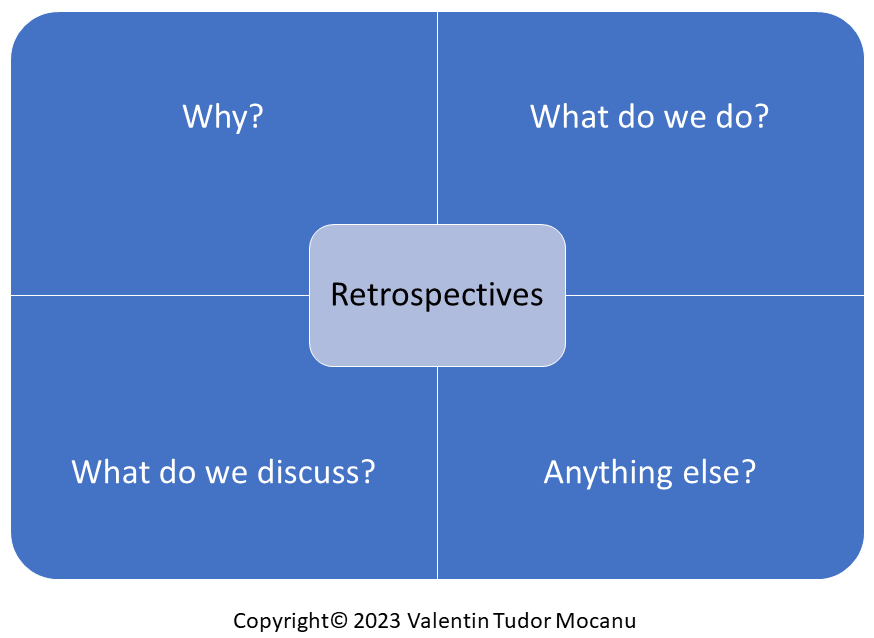
WHY DO WE SKIP RETROSPECTIVES? The most common reason I encounter is that the benefits of retrospectives are not well understood, and only the costs are perceived. An even better question: Why do we hold retrospectives? How can we ensure that the benefits outweigh the costs?
Ask the AI tool: “Why do many Agile teams not conduct retrospectives?
We conduct retrospectives because we aim to adapt and improve our way of working. In Agile, we deliver more frequently, and we validate more often. From a mathematical perspective, it’s all about feedback. In a complex system, continuous feedback is essential for adaptation and optimal functioning.
Ask the AI Tool: What is the rationale behind conducting retrospectives?
WHAT DO WE DO IN RETROSPECTIVES? To effectively apply retrospectives, it’s essential to understand the specific activities involved. Here are some examples:
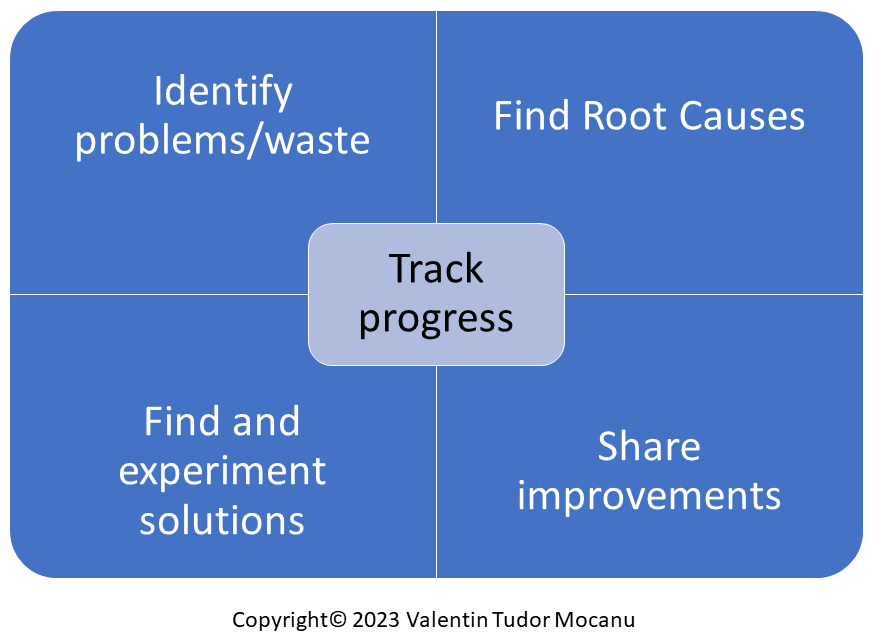
- We discuss problems in our workflow that require resolution. It’s not necessary to solve these problems during the meeting; instead, we can document and plan for their resolution.
- Share knowledge about improvements. This aspect is often overlooked. Continuous improvements are constantly being made, but it’s crucial to share these improvements with both the team and the organization.
“At regular intervals, the team reflects on how to become more effective, then tunes and adjusts its behavior accordingly.”
Principles behind the Agile Manifesto https://agilemanifesto.org/principles.html
WHAT SHOULD BE THE SUBJECT OF OUR RETROSPECTIVES (IMPROVEMENT EFFORTS)? It’s crucial to have a clear understanding of the types of subjects we are addressing and to prioritize those that are most significant to us. In general, our aim is to reduce and eliminate sources of waste from our processes. Here are some specific examples that I often recommend:
- Addressing Technical Debt: Identify, avoid, and eliminate technical debt.
- Collaborative Ways of Working: We want collaboration to be effective and adaptable to our needs.
- Delays: Identifying, accommodating, or eliminating delays in our processes.
- Accelerating Value Delivery.
- Managing and eliminating defects: Identify, avoid, and remove defects.
DA BROWSER – RETROSPECTIVES AND THE IMPROVEMENT PROCESS – Retrospectives, on their own, will not solve problems; they must be integrated into a broader framework of improvement. If you’re looking for guidance on structuring such an approach, you can turn to the DA Browser.
So, what does the DA Browser tell us about retrospectives? A search for “retrospectives” (and possibly “retrospective”) leads us to the “Value Stream” section, specifically the process blade labeled “Continuous Improvement”. Here, you’ll find various options, and “Team Retrospective” is one of them. Additionally, you can conduct Cross-Team retrospectives, which are particularly valuable in organizations with teams of teams or teams collaborating within a value stream.
Furthermore, under “Continuous Improvement” you’ll discover strategies and options for using retrospectives and organizing continuous improvement efforts. This includes identifying improvements, analyzing root causes, sharing improvements, and documenting them.
REFERENCES
[B1 – DA Browser] – Disciplined Agile Browser
https://www.pmi.org/disciplined-agile/da-browser
[B2 – AM Principles] – Principles behind the Agile Manifesto
 Improve With Agile