Three fundamental questions:
- What is the use of collaboration?
- What are the different styles of collaboration?
- How do we know if we are collaborating sufficiently?
What is the use of collaboration?
Ask an AI tool: what is the use of collaboration?
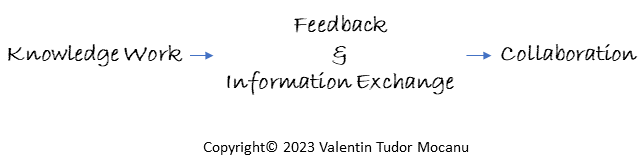
When dealing with knowledge work, it can become difficult or even impossible to plan too much upfront. Instead, we need a system that relies on feedback and information exchange. For people, the initial step involves adopting a collaborative approach. This approach allows us to comprehend problems more swiftly, discover more effective solutions, and efficiently distribute the tacit knowledge that should reside within the memory of those involved. Moreover, it significantly enhances our prospects for improvement, among other advantages.
“Individuals and interactions over processes and tools”
from Manifesto for Agile Software Development, https://agilemanifesto.org/
What are the different styles of collaboration?
We have various ways of working: individually, through meetings, or collaboratively with two or more people, either on a regular or opportunistic basis.
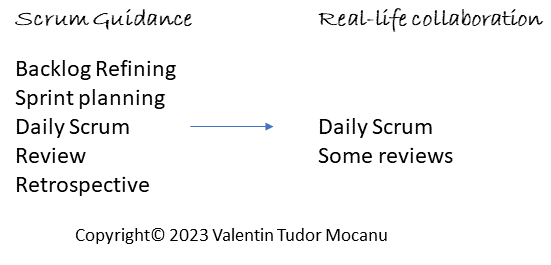
But what is the primary reference for most agile teams? Primarily, Scrum serves as the reference point, which prescribes several key meetings and, albeit vaguely, emphasizes the need for teamwork and collaboration, particularly in “backlog refining”. In practice, this involves daily meetings, occasional review sessions or collaborative planning, and even less frequent retrospectives.
On the other hand, Extreme Programming (XP), while not as commonly adopted by many agile teams, is favored by prominent contributors in the Agile domain. XP advocates for continuous pairing, which is a well-known practice. However, what’s less known is that XP also suggests a complementary approach: moving people around.
How do we know if we are collaborating sufficiently?
Let’s delve into Scrum meetings, even taking into account the fact that some are occasionally skipped. Are they adequate for achieving the objectives we outlined earlier? Not quite.
Now, let’s shift our focus to the crucial aspect of sharing tacit information—whether it’s related to management, technical knowledge, or agile practices. Relying solely on Scrum meetings falls short in this regard.
Yet, when we explore the practices from Extreme Programming (XP), such as pair programming and the concept of moving people around, it becomes apparent that we’re making more substantial progress. With these practices, we establish a default level of collaboration for every activity, and we gain exposure to various types of information by regularly rotating team members.
But there are still many questions that require other options. Here are some examples:
- Do we have the possibility to maintain continuous pairing?
- When tackling challenging problems, is it adequate for the initial pair to work on the solution, or should they also engage in discussions with other colleagues?
- If I require faster dissemination of information, can I achieve it merely by combining the effects of pairing and moving people around?
- Do we effectively communicate with collaborators from outside the team?
“Promise: Collaborate Proactively”
from Disciplined Agile Mindset –
https://www.pmi.org/disciplined-agile/mindset/promises/collaborate
I have some recommendations:
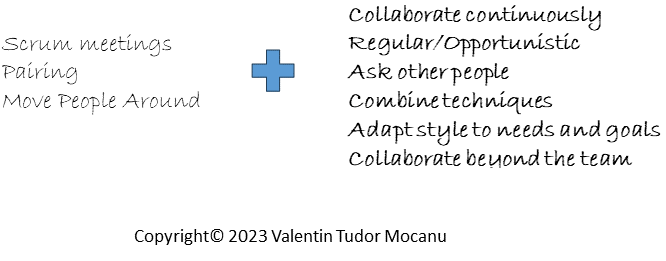
- Depending on the specific needs, we should carefully choose our collaboration styles and consider combining them.
- When faced with challenging problems, we must ensure we have chosen the appropriate collaboration approach and that the people who can help us also participate.
- Collaborate continuously – collaboration should be applied in all temporal perspectives: looking ahead, just in time, and review/retrospective. This means that continuous collaboration, during the design sketch phase, throughout the process, and during the validation can be highly beneficial.
- We should also be prepared to adjust the number of participants according to the specific needs.
- We must collaborate effectively not only within the team but also between teams, with clients and other stakeholders, as well as across the organization. (See [B4 – DA Mindset])
“Ask” Disciplined Agile Browser
For the various collaboration styles, in the Disciplined Agile Browser look for Delivery – Ongoing — Evolve Way of Working (WoW) — Choose Collaboration Styles. There you can find the various options and the associated trade-offs for each of these styles. I’m pleased to recall that I suggested introducing this aspect in the reviews for DA Browser (initially, there was only the Communication style).
Other tangential topics from DA Browser:
- Delivery – Ongoing — Evolve Way of Working (WoW) — Choose communication Style
- Delivery – Ongoing — Coordinate Activities
- Value Stream — Program Management — Coordinate Teams
REFERENCES
[B1 – DA Browser] – Disciplined Agile Browser
https://www.pmi.org/disciplined-agile/da-browser
[B2 – AM] – Manifesto for Agile Software Development
[B3 – AM Principles] – Principles behind the Agile Manifesto
https://agilemanifesto.org/principles.html
[B4 – DA Mindset] – DA Mindset, Promise: Collaborate Proactively
https://www.pmi.org/disciplined-agile/mindset/promises/collaborate
[B5 – Scrum guide] – Scrum guide online
https://scrumguides.org/scrum-guide.html
[B6 -XPE1] – Extreme Programming Explained First Edition, By Kent Beck, Addison-Wesley, 1999
[B7 -XPE2] – Extreme Programming Explained: Embrace Change, Second Edition, By Kent Beck, Cynthia Andres, Addison-Wesley, 2004
 Improve With Agile